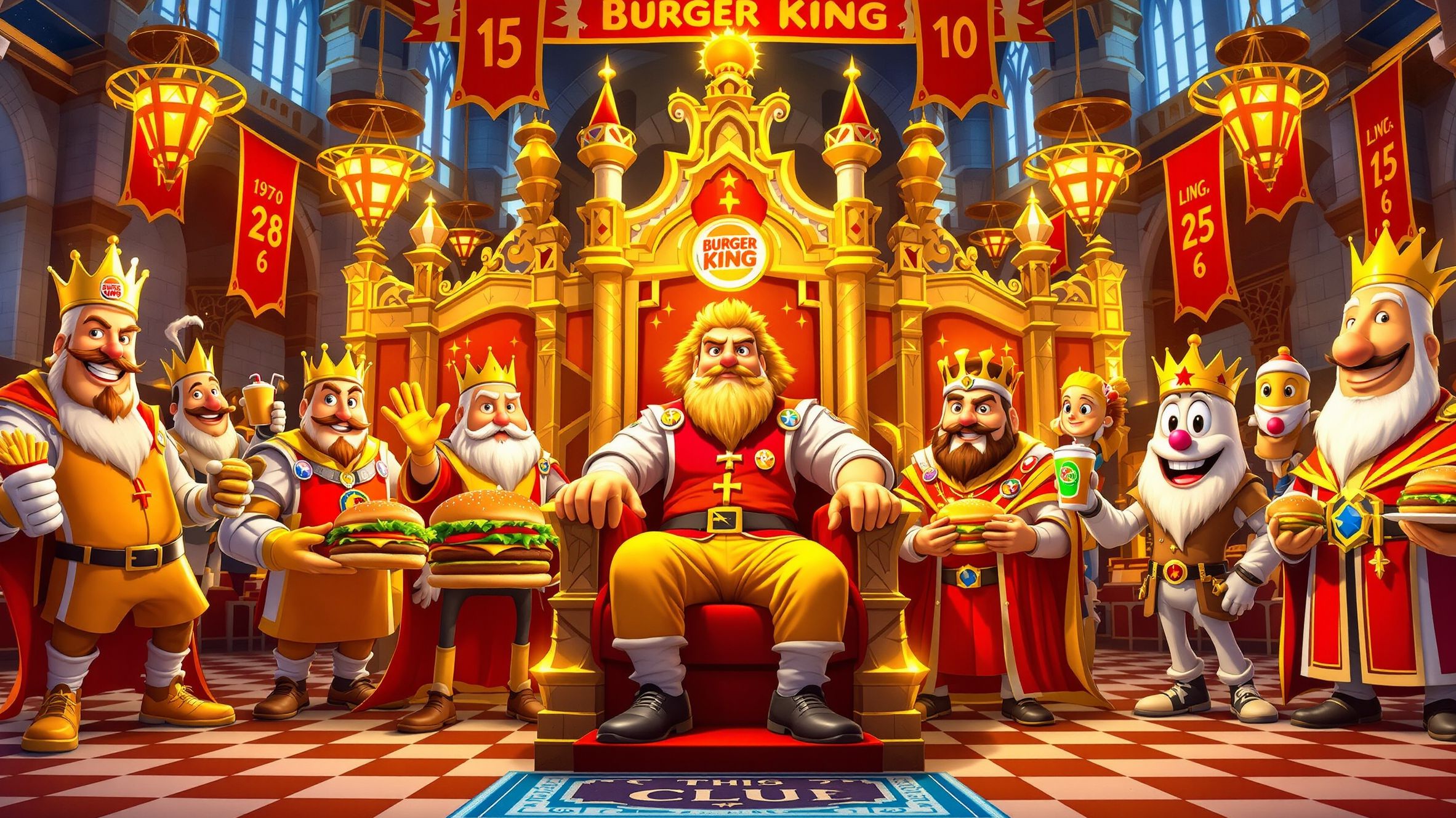
Few fast-food mascots have changed as dramatically as Burger King’s famous royal spokesperson. Since the restaurant opened in 1954, the King has gone from a simple cartoon illustration to a magical ruler, a family-friendly character, and even one of the internet’s creepiest advertising icons. Each redesign reflected changing trends in advertising and pop culture, proving that even a king has to reinvent himself to stay relevant. Some versions became childhood favorites, while others sparked endless memes and debates. Here are the ten biggest makeovers that transformed Burger King’s mascot throughout the years.
#1: The Original Burger King (1955)
The very first Burger King mascot looked nothing like the one most people recognize today. He was a friendly illustrated king seated on a massive burger throne while holding a drink and smiling at customers. This version appeared primarily on restaurant signs and printed advertisements rather than television commercials. His simple design introduced the “royal” theme that would define the brand for decades. Although he lacked a flashy personality, his image immediately told customers they were visiting a place where burgers were fit for a king. It’s easy to overlook this original mascot today, but without him, none of the later versions would have existed.
#2: The Animated King
As television became the dominant form of advertising, Burger King updated its mascot into a colorful animated character. This version smiled constantly, interacted with children, and appeared in cheerful commercials promoting burgers, fries, and shakes. His expressive face and playful personality made him much more approachable than the static illustration that came before him. Kids quickly recognized him, and Burger King used the character to compete with other family-friendly restaurant mascots during the 1970s. The makeover proved that the King could become a real personality instead of just a logo.
#3: The Magical Burger King
One of the biggest transformations arrived in the mid-1970s when Burger King introduced a live-action King with a flowing red beard, royal robes, and magical powers. This version ruled the whimsical Burger King Kingdom and could seemingly produce burgers out of thin air using his enchanted ring. Commercials featured castles, knights, and fantasy adventures that entertained children while promoting the restaurant. The magical King became one of the chain’s longest-running mascots and remains one of the most nostalgic versions for fans who grew up in the late 1970s and 1980s.
#4: The Burger King Kingdom Expansion
The King received another makeover when Burger King expanded his world into a full royal kingdom. Instead of appearing alone, he was joined by quirky companions like Sir Shake-a-Lot, the Wizard of Fries, and the Duke of Doubt. This makeover wasn’t just about his appearance—it completely changed how he was presented. Commercials became mini fantasy adventures instead of traditional advertisements, making Burger King feel like a magical place where anything could happen. It was one of the company’s most creative advertising periods.
#5: The Family-Friendly King
During the late 1980s and early 1990s, Burger King shifted away from fantasy and focused more on families. The King became friendlier and shared the spotlight with the Burger King Kids Club, a group of diverse cartoon children who represented everyday kids. Instead of magical adventures, commercials focused on friendship, birthday parties, and family meals. This makeover modernized the mascot while helping Burger King appeal to a new generation of young customers.
#6: The Creepy Masked King
After disappearing from advertising for several years, the King returned in 2004 with perhaps the most shocking makeover in fast-food history. Instead of a traditional mascot, Burger King introduced an oversized plastic mask with a permanently frozen smile. The silent King unexpectedly appeared in bedrooms, sporting events, offices, and other strange places, always holding a Whopper. Some viewers found him hilarious, while others admitted he was genuinely unsettling. Regardless of opinion, everyone remembered him, making it one of the most successful mascot reboots in advertising.
#7: The Viral Internet King
The masked King’s bizarre appearance quickly spread across the internet. His expressionless smile inspired countless memes, parody videos, Halloween costumes, and online discussions. Few restaurant mascots have generated as much internet attention without saying a single word. Rather than hurting the brand, his strange makeover made Burger King impossible to ignore. Years later, the creepy King remains one of the most recognizable advertising characters ever created.
#8: The Celebrity Companion
As the years went on, Burger King reinvented the King once again by placing him alongside celebrities, athletes, and major sporting events. Instead of carrying entire commercials by himself, he became a surprise guest who silently stole scenes with his oversized grin. This makeover shifted him from starring role to comedic sidekick, proving he could remain entertaining without dominating every advertisement.
#9: The Softer Modern King
Burger King eventually toned down the King’s creepier qualities while keeping his iconic oversized head. Newer commercials portrayed him as more playful than unsettling, using slapstick humor and food-focused jokes rather than awkward surprise appearances. Fans appreciated that the company preserved his signature look while making him feel less intimidating to younger audiences. This subtle redesign helped extend the mascot’s popularity well into the modern advertising era.
#10: The King’s Quiet Exit
In recent years, Burger King has focused more on its menu items than its royal mascot. The King still appears occasionally in promotional materials and nostalgic campaigns, but he no longer dominates television advertising the way he once did. Instead of a dramatic redesign, this final makeover came through reduced visibility. The mascot evolved from the face of the company into a nostalgic icon remembered by longtime fans. While he may not rule every commercial anymore, his legacy remains firmly cemented in fast-food history.
Conclusion
From a simple illustrated monarch to one of advertising’s strangest viral sensations, Burger King’s mascot has experienced an incredible evolution. Every makeover reflected a different generation of customers and a different philosophy of marketing. Some versions were whimsical, others magical, and a few were unforgettable simply because they were so unusual. Whether your favorite is the classic bearded King or the silent masked version, there’s no denying that Burger King’s mascot has worn more crowns than almost any other fast-food character, making him one of the most fascinating icons in advertising history.