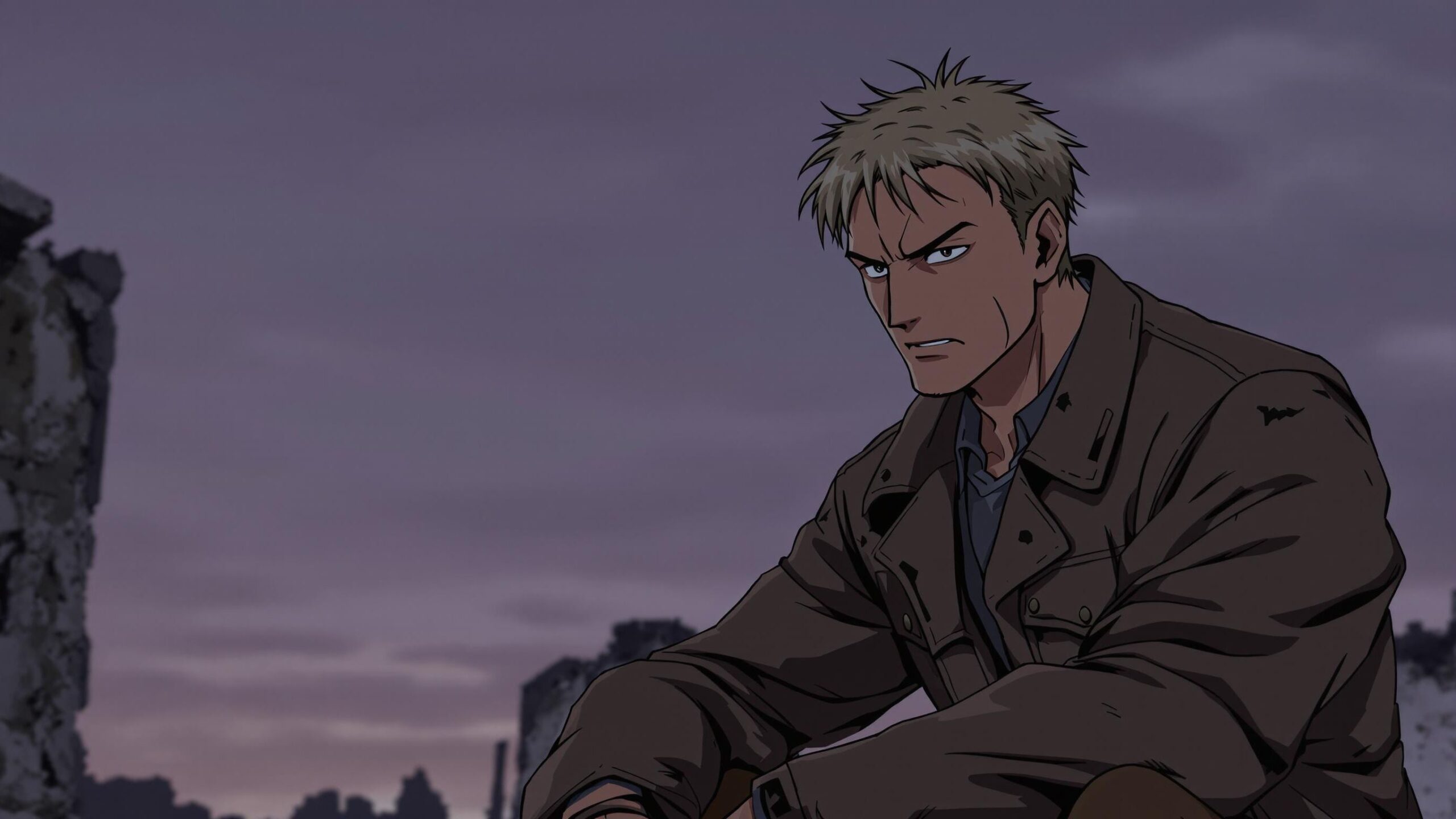
Reiner Braun is one of the most emotionally complex and painfully human characters in Attack on Titan. A warrior trapped between two worlds, Reiner’s journey is marked by unbearable guilt, fractured identity, and endless loss. From the outside, he’s a powerful soldier—the Armored Titan and spearhead of Marley’s infiltration mission. But beneath the armor lies a man breaking apart under the weight of his choices. Reiner is a walking contradiction: both hero and villain, both victim and executioner. His story is not just one of war—but of suffering. These ten tragic moments capture the unbearable burden Reiner carries and the emotional toll of a life defined by betrayal, duty, and regret.
#10: Reiner’s Breakdown After Marco’s Death
One of the first cracks in Reiner’s carefully constructed warrior persona occurs after the horrifying death of Marco Bott. During the Battle of Trost, Reiner, Annie, and Bertholdt restrain Marco and allow a Titan to kill him—just to keep their identities secret. Marco’s panicked screams of “We’re just talking, right?” still echo as one of the most disturbing betrayals in the series. But it’s not just the act that’s heartbreaking—it’s Reiner’s response afterward. He experiences a complete mental break, compartmentalizing the atrocity so intensely that he forgets he was responsible. Later, when he stumbles upon Marco’s remains, he breaks down in front of Jean, sincerely asking, “Why did he die?” It’s haunting because Reiner’s split identity has begun to protect him from the reality of his crimes. It’s not just tragic—it’s terrifying. He’s so consumed by guilt that he has to forget to survive. This is where we begin to see that Reiner is not the cold-hearted villain he pretended to be—he’s a traumatized teen trying desperately to carry the weight of a monstrous secret.
#9: Reiner’s Dual Identity as Soldier and Warrior
Reiner’s mental fragmentation becomes one of the central tragedies of his character. After years of pretending to be a loyal member of the Survey Corps, Reiner can no longer separate who he really is. He doesn’t just act like a soldier—he believes he is one. At times, he forgets that he’s the enemy. At others, he fully embraces his role as Marley’s warrior. This internal schism is painfully apparent when Bertholdt has to remind him of their mission, forcing him to snap out of his self-imposed delusion. “You’re a warrior, not a soldier,” Bertholdt tells him, shaking him from his fugue-like state.
The tragedy here is that Reiner isn’t faking—he’s protecting himself. He’s forced to live among the very people he plans to destroy, and in doing so, grows to care for them. The only way he can keep functioning is by disassociating, burying his guilt beneath layers of false identity. It’s a devastating psychological cost that makes every moment he spends with the 104th—laughing, fighting, bonding—feel like a ticking time bomb. Reiner’s war isn’t just external. It’s inside his own mind.
#8: Reiner Confesses to Eren
In one of the most emotionally charged scenes in Attack on Titan, Reiner calmly confesses to Eren that he is the Armored Titan. There’s no dramatic reveal, no evil laughter. Just quiet desperation. “It’s been hell,” Reiner mutters, eyes tired, shoulders heavy with years of betrayal. He doesn’t confess to gain sympathy—he does it because he’s breaking. He can no longer live the lie. The haunting part of this moment isn’t just that Reiner exposes himself—it’s how visibly tired he is of hiding.
Eren, stunned by the surreal calm of it all, can’t even process it at first. Reiner’s confession isn’t an act of power—it’s a cry for release. He’s not trying to intimidate or justify. He’s trying to be heard. And that makes the moment all the more tragic. For all his armor and strength, Reiner is simply a man who’s been living in torment for too long. He confesses not as a warrior—but as a broken human being desperate to end the charade.
#7: Reiner Tries to Kill Himself
By Season 4, Reiner’s emotional deterioration reaches its lowest point. Alone in his room, haunted by memories of the comrades he betrayed and the children he’s training to do the same, Reiner puts a gun in his mouth. He’s ready to end it all. He’s tired of being the traitor, the protector, the enemy, the hero—he just wants peace. It’s one of the most harrowing moments in the series. But just as he’s about to pull the trigger, he hears Falco’s voice outside—innocent, hopeful, and utterly unaware of how close Reiner is to the edge.
That voice stops him.
It’s an unspeakably powerful moment. Reiner lives not because he wants to—but because someone needs him to. And that’s been his curse from the start. He never asked to be a warrior. He was forced into it. And now he can’t escape it—not even in death. His survival in that moment isn’t a victory—it’s a tragedy. A continuation of pain he no longer wants to endure but feels obligated to carry.
#6: Reiner Watches His Friends Die One by One
Throughout the series, Reiner experiences the slow, painful unraveling of every relationship he’s tried to preserve. From his comrades in Marley to the friends he betrayed on Paradis, Reiner carries the weight of every death—and every failure. He watches as Bertholdt is consumed by Armin’s resurrection, as Annie becomes crystalized and isolated, and as Marcel, the leader of their warrior group, is eaten before their mission even begins. Each loss chips away at his psyche, and he carries the blame for all of it.
What makes this so tragic is that Reiner sees himself as the glue that was supposed to hold everyone together. When things fall apart, he doesn’t just mourn—he internalizes it. The deaths of Porco, Ymir, and the other warriors deepen the chasm of guilt he’s already drowning in. Unlike Eren, who learns to weaponize his grief, Reiner crumbles under it. He doesn’t use pain to grow stronger—he absorbs it until it crushes him. Every time someone dies around him, you can see a part of Reiner die too, and yet he’s forced to keep fighting. It’s a cruel cycle of survival without peace, and Reiner is its most tortured participant.
#5: Reiner Is Rejected by His Homeland
Reiner dedicates his life to serving Marley. He trains as a child soldier, carries out one of the most dangerous infiltration missions in history, and fights against his own people to prove his loyalty. And yet, when he returns home, he’s not met with praise—he’s met with suspicion, propaganda, and the cold reality that Marley doesn’t care about its warriors. The most heartbreaking part? Reiner still tries to serve them. Even after seeing how disposable, he and his comrades are, he continues to fight, hoping that maybe his efforts will mean something.
The scene where Reiner sits down for dinner with his mother and Falco is especially haunting. His mother parrots Marley’s propaganda, praising his “mission” and demonizing the Eldians on Paradis—even though she’s Eldian herself. Reiner smiles weakly, knowing it’s all a lie. Knowing that he sacrificed everything, and in return, was given nothing but more chains. His homeland, the very place he risked everything to protect, sees him not as a hero—but as a tool. That quiet rejection is more devastating than any battlefield defeat.
#4: Reiner vs. Eren—Their Final Battle
When Reiner faces off against Eren in the latter stages of the war, it’s not just a battle between two Titans—it’s a battle between two broken ideologies. Reiner fights not because he believes in Marley anymore, and not because he hates Eren. He fights because he has to. Because if he doesn’t, someone else—Falco, Gabi, the children—will die. Watching Reiner suit up for yet another hopeless battle is gut-wrenching. His eyes are hollow. His movements heavy. He’s not inspired. He’s not angry. He’s just tired.
Eren, now fully embracing the role of destroyer, represents the kind of monstrous freedom Reiner once tried to prevent. Their clash is filled with history, regret, and resignation. Reiner isn’t trying to win—he’s just trying to end it. To stop the suffering. To protect what little he has left. And in doing so, he becomes the embodiment of tragic duty—a man fighting a war he no longer believes in, against a friend he once tried to save.
#3: Reiner Witnesses Eren’s Massacre
During the Rumbling, Reiner sees firsthand the horror of Eren’s actions. Cities flattened. Innocents slaughtered. Children crushed beneath the feet of countless Colossal Titans. Reiner, who once carried out similar atrocities in the name of “saving the world,” is now forced to witness that same logic taken to its extreme. And he’s helpless to stop it. This moment is particularly tragic because it forces Reiner to confront the consequences of every lie, he ever told himself. He thought he was protecting the world. He thought he could control the outcome. But now, he sees that violence—no matter how justified—only breeds more destruction.
Watching Reiner’s face as he sees the end of the world unfold is devastating. He doesn’t scream. He doesn’t rage. He just watches, paralyzed by guilt. For once, he’s not a soldier. He’s just a man who failed to stop the monster he helped create. And that knowledge breaks him more than any battle ever could.
#2: Reiner Fails to Protect Falco
Despite all his failures, Reiner clings to one last hope: protecting the next generation. Falco, in particular, becomes a surrogate son to him—someone he sees potential in, someone he wants to save. But even that simple dream falls apart. Falco is dragged into battle, infected with spinal fluid, and ultimately becomes a Titan shifter. Reiner’s one mission—to spare a child from the hell he lived through—ends in total failure. The anguish in his voice when he realizes what’s happened is impossible to forget.
He tried so hard to be better. To change the outcome. To prevent the cycle. But war finds a way to drag everyone into its maw, even the innocent. Reiner’s inability to protect Falco isn’t just a moment of personal failure—it’s a symbol of how impossible it is to break free from systemic violence. No matter how hard he tries, Reiner remains trapped. And now, so does Falco.
#1: Reiner’s Entire Life as a Living Apology
More than any single event, the greatest tragedy of Reiner Braun is that his entire life becomes a prolonged apology. He doesn’t sleep peacefully. He doesn’t love freely. He doesn’t live proudly. Every decision he makes is haunted by the people he’s lost, the lies he’s told, and the futures he’s destroyed. Whether he’s throwing himself in front of children to protect them or volunteering to die instead of someone else, Reiner’s every move is soaked in remorse.
Unlike other characters, Reiner doesn’t try to justify his past. He owns it. He hates it. And he carries it with him like a coffin strapped to his back. His heroism is never flashy. It’s quiet. Reluctant. Born of pain, not pride. And that’s what makes him so tragic. He isn’t trying to be a savior. He’s just trying to atone. And the worst part? He never believes he deserves forgiveness. Not from his friends. Not from the world. And certainly not from himself.
Reiner Braun’s journey is not one of redemption or revenge—it’s a slow-motion collapse of a man burdened by impossible choices. His life is defined by the tension between duty and humanity, truth and lies, guilt and survival. Each tragic moment highlights not just his mistakes, but his inability to escape the consequences of them. Reiner doesn’t fight because he wants to win. He fights because he believes he has to. And that quiet suffering is what makes his story one of the most heartbreaking in all of Attack on Titan.