
There are few characters in the world who are instantly recognizable across generations, cultures, and continents—and among them, none is quite as timeless, endearing, and universally beloved as Hello Kitty. From her humble beginnings in 1974 to her modern-day reign as a global pop culture sensation, Hello Kitty has managed to capture the hearts of millions with her simple charm, signature bow, and quiet message of friendship and kindness. She might be small, and she might not even have a mouth, but Hello Kitty speaks louder than most, whispering joy, nostalgia, and innocence wherever she goes.
Born in Japan, Loved Everywhere
Hello Kitty was created by Sanrio, a company originally known for silk goods but which pivoted into character branding in the 1970s. The idea was simple: create a character that would appeal to young girls and could be used to decorate cute merchandise. Yuko Shimizu, the original designer, drew a white kitten wearing a red bow and overalls, sitting beside a bottle of milk. She called her “Kitty White,” and she was soon known to the world as Hello Kitty. Though her name and concept may sound British, that was entirely intentional—Sanrio believed that British culture would appeal to Japanese audiences during a time when all things Western were considered fashionable. Her very first appearance was on a small vinyl coin purse, and from there, Hello Kitty’s empire grew exponentially. Today, her image graces more than 50,000 products each year—from lunchboxes and backpacks to airplanes, theme parks, and even luxury jewelry. It’s not just children who adore her; Hello Kitty’s universal appeal has made her an icon for adults, artists, and designers alike.
The Magic of Simplicity
One of Hello Kitty’s most defining characteristics is, ironically, what she lacks: a mouth. Her creator, Yuko Yamaguchi (who took over from Shimizu in the 1980s), once explained that Hello Kitty’s lack of a mouth allows people to project their own feelings onto her. Whether you’re happy, sad, excited, or reflective, Hello Kitty reflects you. She becomes what you need her to be in the moment. This design decision has created a remarkable psychological bond between the character and her fans, deepening her resonance in ways few other fictional figures have achieved. Her overall design is also astonishingly minimalist. With just a few lines and a red bow, Hello Kitty proves that charm doesn’t require complexity. She is approachable and comforting in her simplicity, and that’s part of the reason she continues to appeal to people of all ages. Children love her because she’s gentle and sweet; adults find nostalgia, whimsy, and even irony in her omnipresence.
Hello Kitty’s World and Friends
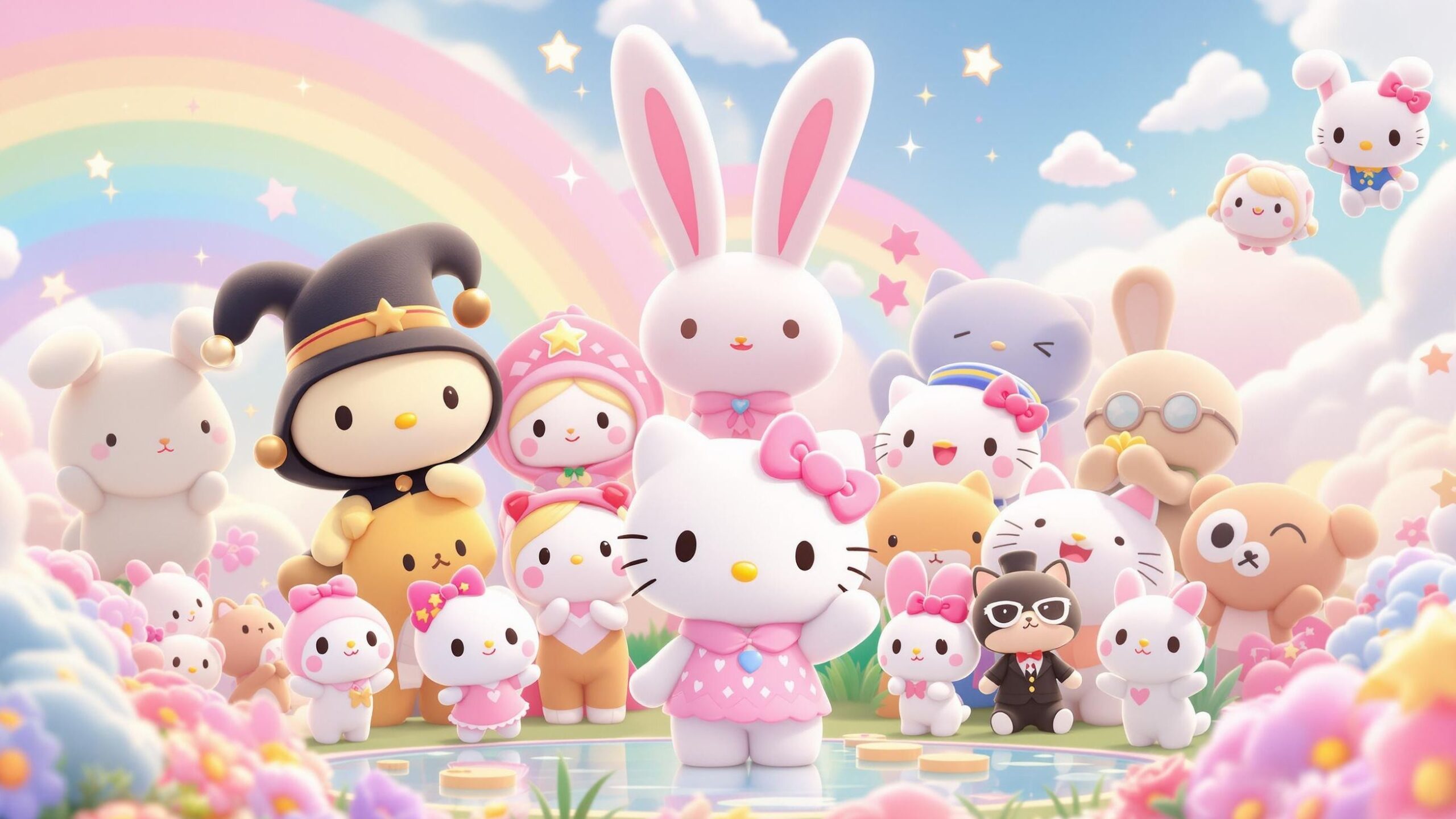
Hello Kitty isn’t alone in her charming world. She has a family, a host of friends, and a fictional setting called “London suburbs,” where she lives with her twin sister Mimmy, her parents Mary and George, and a roster of delightful companions. Mimmy is distinguished from Hello Kitty by her yellow bow (on the opposite ear), and she’s a little more shy and reserved than her outgoing sister. Their family dynamic is traditional and loving, reinforcing the themes of warmth and togetherness that pervade Hello Kitty’s universe. She also has a delightful group of friends, including My Melody (a pink-hooded bunny), Badtz-Maru (a mischievous penguin), Keroppi (a fun-loving frog), and Chococat (a curious cat with a chocolate-colored nose). Each friend has their own quirks, adventures, and fan base. Hello Kitty’s relationships with them are always nurturing, imaginative, and full of laughter—a confirmation to the power of friendship in her whimsical world.
From Pencils to Planes: The Hello Kitty Empire
There’s no underestimating the sheer breadth of Hello Kitty’s empire. While many cartoon characters are content to remain on stationery or television, Hello Kitty has spread her paws into nearly every industry imaginable. There’s a Hello Kitty café in multiple countries. There are Hello Kitty maternity wards in Taiwan. There are Hello Kitty credit cards, themed hotel rooms, and even a Hello Kitty-themed bullet train in Japan. In 2008, Hello Kitty was appointed the official Japanese ambassador for tourism in China and Hong Kong—a role no other fictional character had ever held before. What makes this expansion so unique is that Hello Kitty products span every price point. You can buy a $1 Hello Kitty pencil or a $1,000 Hello Kitty Swarovski crystal pendant. She appears in both mass-market merchandise and luxury brand collaborations, with past partnerships including MAC Cosmetics, Levi’s, and even Vans. Hello Kitty isn’t just a character; she’s a lifestyle, a mood, and a design philosophy all at once.
Cultural Impact and Legacy
Hello Kitty has had a profound cultural impact that goes far beyond the realm of childhood merchandise. In many ways, she’s a symbol of “kawaii” culture—a uniquely Japanese aesthetic that values cuteness, softness, and innocence. But she also became a form of rebellion and irony in Western subcultures. Punk rockers in the early 2000s famously wore Hello Kitty pins, tattoos, and t-shirts, using the hyper-cuteness as an antithesis to aggressive trends. She has been featured in artwork by Takashi Murakami and even inspired entire fashion lines from brands like Balenciaga. Celebrities such as Lady Gaga, Katy Perry, and Paris Hilton have flaunted Hello Kitty-themed wardrobes. Her face has appeared on everything from smart cars to guitars. Hello Kitty’s cultural versatility is unparalleled, allowing her to exist as both a childhood treasure and a postmodern icon. She represents innocence, but also serves as a blank canvas for complex cultural conversations about consumerism, femininity, and nostalgia.
The Power of Nostalgia
Part of Hello Kitty’s ongoing success lies in her nostalgic power. For many people, Hello Kitty is tied to their earliest memories—perhaps a pink lunchbox from kindergarten, a pair of slippers, or a sticker book filled with dreams. The sight of Hello Kitty invokes a flood of childhood emotions: safety, fun, creativity, and simplicity. In a world increasingly overwhelmed by chaos and complexity, she offers a quiet reminder of days when joy came from coloring books and bubblegum-scented erasers. But she’s not stuck in the past. Hello Kitty continues to evolve with her audience. From emoji packs and mobile games to Instagram-worthy merchandise and anime adaptations, she’s everywhere that fans are, always ready to reintroduce herself to new generations. She never has to change much—because the world changes around her, and she remains an anchor of gentle optimism.
A Global Family
Hello Kitty is one of the rare characters who has transcended not only time but geography. She is as beloved in the United States as she is in Japan, as iconic in South America as she is in Europe. She communicates without words, her imagery cutting across linguistic and cultural boundaries. Parents and children can love her side-by-side, sharing stickers, plushies, and t-shirts like precious heirlooms. Sanrio has leaned into this global warmth with collaborations that appeal to every age and nationality. In the Philippines, Hello Kitty has been featured on public transportation and school supplies. In Brazil, she’s been the face of a major children’s fashion line. In the UK, she maintains her original British backstory with high tea sets and storybooks. No matter where you go, Hello Kitty finds a way to blend into the culture while still remaining uniquely herself.
Hello Kitty in Media
Although Hello Kitty is best known for her merchandise, she’s also been featured in a wide variety of media. She’s had animated series such as “Hello Kitty’s Furry Tale Theater” and “Hello Kitty and Friends Supercute Adventures,” which delight children with sweet storytelling and colorful animation. These shows bring her to life with gentle humor and moral lessons, reinforcing her role as a positive influence for young audiences. She has also starred in several video games, spanning consoles from the Nintendo DS to the mobile app market. These games emphasize creativity, problem-solving, and imagination rather than violence or competition. True to form, Hello Kitty’s world encourages cooperation, caring, and a sense of wonder, even in digital form.
The Enigma of Personality
One of the most fascinating things about Hello Kitty is how mysterious she remains, even after 50 years of popularity. She’s not a typical character with a well-defined arc or backstory. She’s more of an avatar—a gentle spirit who exists to befriend, comfort, and accompany you through life. This ambiguity gives her an almost mythical status in pop culture. She’s whatever you want her to be—a friend, a muse, a mascot, or a mirror. Sanrio has provided a few details about her life: she’s a Scorpio, born on November 1, loves baking cookies, and dreams of becoming a pianist or poet. But beyond that, she remains flexible and open-ended. Her simplicity is her superpower. She doesn’t need dramatic plotlines or complex motivations to be impactful. She is love, distilled to its most innocent form.
Why Hello Kitty Still Matters
In a world often marked by cynicism, division, and the constant churn of trends, Hello Kitty’s enduring appeal is a quiet miracle. She reminds us of something essential—that joy can be simple, that kindness matters, and that a little bit of cuteness can make a big difference. She’s a balm for weary hearts and a spark of playfulness in an otherwise serious world. More than a brand, more than a character, Hello Kitty is a cultural ambassador of joy. Whether you’re five or fifty-five, she offers something meaningful: a return to wonder, a smile, and a chance to remember that happiness can often be found in the smallest things. She’s not just a cat with a bow—she’s a timeless friend with a universal heart.
The Future Is Bright—and Pink
As Hello Kitty moves into her next 50 years, there’s no sign that her star is dimming. If anything, she continues to glow brighter with each passing generation. Sanrio continues to innovate with digital experiences, inclusive branding, and new collaborations that keep her fresh while respecting her roots. Whether she’s flying through space in an animation, decorating high-fashion runways, or gently smiling from the corner of a child’s notebook, Hello Kitty is always exactly where she belongs. The future is filled with possibility—and it’s wearing a red bow. And in that future, Hello Kitty will continue doing what she does best: bringing people together, making the world a little cuter, and reminding us all to slow down, smile, and find happiness in the everyday.